
Welcome to the Anti-Racism Webpage
This site is designed to support educators in creating inclusive, culturally responsive, and anti-racist learning environments. Resources are intended to support ongoing learning, reflection, and classroom implementation aligned with BC curriculum, the BC Human Rights Code, Truth and Reconciliation Calls to Action, and BC Professional Standards for Educators.
⭐ New ⭐
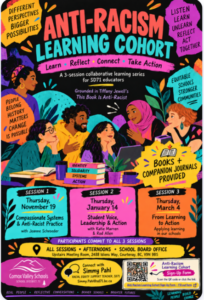
Anti-Racism Learning Cohort
Join educators from across SD71 for a collaborative learning cohort focused on strengthening anti-racism practice, student voice, and belonging. Open to 30 educators working in Grades 5–9 classrooms, participants will explore practical strategies, share resources, and build connections through three learning sessions.
Youth Racial Equity Micro-Grants
B.C. youth ages 16–24 can apply for up to $1,000 to create anti-racism projects that positively impact their school communities and foster resilience, healing, cultural safety, and belonging.
📅 Application window: September 29–October 30, 2026
Projects must be completed by May 31, 2027.
- Anti-racism is the active, conscious process of identifying and opposing racism. It goes beyond simply not being personally prejudiced by requiring deliberate action to dismantle the systemic barriers, policies, and institutional structures that perpetuate racial inequality and oppression.
- Systemic racism refers to how societal structures—such as laws, policies, and institutional practices—routinely produce racially inequitable outcomes. Unlike individual prejudice, it operates at a macro-level, meaning organizations and social systems can perpetuate racial disparities even without conscious bias from the individuals running them.
- Privilege is a special advantage, right, or immunity granted to a specific person or group, often to the exclusion of others. It can be something earned, legally sanctioned (like a driver’s privilege), or an unearned advantage based on social circumstances.
- A stereotype is a widely held, oversimplified, and generalized belief about a specific group of people. It involves assuming all individuals in that group share the exact same characteristics, traits, or behaviors, ignoring their unique personalities and individuality.
- A microaggression is a subtle, everyday comment, gesture, or behavioral slight that expresses a prejudiced or stereotypical attitude toward a member of a marginalized group. These remarks are often unintentional and may even be disguised as compliments, but they serve to isolate or demean the recipient.
- Bias is a disproportionate preference or inclination for or against an idea, thing, or group of people, usually in a way that is closed-minded, prejudicial, or unfair. It acts as a mental shortcut that influences judgment and prevents objective analysis.
Culture Is Not a Costume: Halloween & Cultural Appropriation
Cultural appropriation can occur when elements of a culture—such as clothing, regalia, hairstyles, symbols, traditions, or sacred items—are used without understanding, respect, or acknowledgement of their cultural significance.
Halloween and other dress-up events can provide opportunities for age-appropriate conversations about identity, stereotypes, respect, cultural appreciation, and belonging.
A Note for Educators
The resources shared on this page are intended to support professional learning, classroom planning, and conversations about anti-racism, identity, equity, and belonging. Educators should preview all materials, links, videos, and suggested resources before sharing them with students and use their professional judgement to determine their suitability for their particular classroom context.
Please consider the age, developmental readiness, identities, lived experiences, and learning needs of your students, and adapt materials and discussions as appropriate. Some resources may address sensitive topics or experiences of racism and discrimination and may require additional context, preparation, or support.
⭐ Recommended Starting Points
Burnaby Schools — Culture Is Not a Costume
Recommended: Elementary–Secondary | Educator & Student Resource
A BC school-based resource introducing cultural appropriation and providing questions students can use to think critically about costumes. The reflection questions can also be adapted for classroom discussion.
View the Burnaby Schools resource
Vancouver School Board — Culture Is Not a Costume
Recommended: Elementary–Secondary | Educator & Student Resource
A concise resource with an Indigenous Education lens that encourages dialogue about costumes, stereotypes, culture, race, and ethnicity. Includes questions that can help guide conversations with students.
Berkeley Schools — Cultures Aren’t Costumes
Recommended: Elementary–Middle | Student & Family Resource
An accessible checklist that encourages students and families to reflect, discuss, research, and make respectful choices while still keeping costumes creative and fun.
View the Cultures Aren’t Costumes checklist
Student-Facing Resources
Baylor University — My Culture Is Not a Costume
Recommended: Upper Elementary–Secondary
Images and reflection questions designed to encourage students to consider stereotypes, representation, and the impact of turning aspects of people’s identities and cultures into costumes.
Explore My Culture Is Not a Costume
Partnership With Native Americans — Native American Culture Is Not a Costume
Recommended: Upper Elementary–Secondary / Educator Background
Explores why Indigenous cultures, traditional clothing, and regalia should not be treated as costumes. Can support conversations about stereotypes, cultural significance, appropriation, and appreciation.
Read Native American Culture Is Not a Costume
Videos & Discussion Starters
My Culture Is Not a Costume
Recommended: Middle–Secondary | Preview Before Showing
A student-facing video that illustrates the impact of seeing elements of one’s culture or identity represented as costumes. A useful starting point for discussion about stereotypes, impact, and belonging.
We’re a Culture, Not a Costume
Recommended: Middle–Secondary | Preview Before Showing
Introduces key ideas and definitions and provides questions students can consider when evaluating Halloween costumes. Some language and examples make this more appropriate for older students.
Student Perspectives: Culture Is Not a Costume
Recommended: Middle–Secondary
Students respond to questions about culture, costumes, stereotypes, and representation. This could be used as a discussion starter before inviting students to respond to similar questions themselves.
Annual Reminder: Culture Is Not a Costume
Recommended: Middle–Secondary
A short news-style video that can be used to introduce or reinforce conversations about cultural appropriation around Halloween.
Older Students & Educator Learning
Cultural Appropriation vs. Cultural Appreciation
Recommended: Secondary / Educator Background
A longer conversation exploring the distinction between cultural appropriation and cultural appreciation. Useful for developing background knowledge or supporting deeper discussion with older students.
Culture Is Not a Costume
Recommended: Secondary / Educator Background
A video exploring cultural appropriation and its impact. Best suited to mature audiences and useful for extending learning beyond introductory definitions.
Jayden Lim — My Culture Is Not a Costume
Recommended: Secondary / Educator Background | Mature Content
A compelling exploration of cultural appropriation and stereotypes. Contains mature/sexual references and should be previewed carefully before classroom use.
Articles, Campaigns & Further Learning
We’re a Culture, Not a Costume — Student Campaign
Recommended: Secondary / Educator Background
Background on a student-led campaign challenging racial and cultural stereotypes in Halloween costumes. Although an older resource, it can provide useful historical context for examining student activism and representation.
“We’re a Culture, Not a Costume” — Social Media Activism
Recommended: Secondary / Educator Background
Explores cultural and religious appropriation and social-media activism connected to the broader “culture is not a costume” movement.
Culture Is Not a Costume — LSPIRG
Recommended: Secondary / Educator Background
A campaign focused on challenging cultural stereotypes and encouraging reflection about costumes and cultural appropriation.
Culture Is Not a Costume: Raising Awareness Through Cultural Training
Recommended: Educator Background
Additional background reading on cultural appropriation, awareness, and respectful cross-cultural engagement.
Questions for Classroom Discussion
Educators may wish to adapt these questions to the age and context of their students:
- Is the costume based on a culture, race, ethnicity, religion, or identity that is not your own?
- Does it rely on a stereotype or exaggeration?
- Does the clothing, symbol, hairstyle, or item have cultural, spiritual, or historical significance?
- How might someone from that community feel seeing an important part of their identity used as a costume?
- Are we learning about and respecting a culture, or borrowing something because it looks interesting, funny, or “different”?
- What is the difference between appreciating a culture and appropriating it?
- How can we be curious about and celebrate cultures respectfully?
- How can we choose costumes that are creative and fun without turning someone’s culture or identity into a costume?
Moving Beyond “Don’t”
Conversations about cultural appropriation do not need to end with a list of things students should not wear. They can be opportunities to build curiosity, empathy, critical thinking, and respect.
Students can be encouraged to ask:
What can I learn? Who can I listen to? How can I show appreciation respectfully? And how can my choices help others feel that their identities and cultures are valued?
Calling In vs Calling Out
Calling in and calling out are different approaches to responding to a racist incident.
Calling in and calling out can each include possible risks depending on the situation. Both approaches can be complex and should be addressed in a thoughtful way.
In choosing to respond to a racist incident, consider if calling in or calling out is appropriate to the situation that has occurred. It is important to consider the power of your influence when deciding to either call in or call out.
Calling In
Calling in is an invitation to learn. It involves explaining to someone how and why their words or behaviour are harmful. This can be done through a non-public conversation after an incident has occurred. The conversation can be an opportunity to learn and grow.
Calling in can be used:
- When the person responsible for the racist incident may be open to understanding and learning more about why their actions were harmful
- To help shift someone’s thinking, values, or approach towards more respectful, equitably and non-racist ways
- To focus on reflection and learning from an incident, rather than simply reacting or seeking to reprimand the person for what they did wrong
Calling in usually occurs in a non-public space or in private conversation. Examples of how to start a conversation might include the following:
- I’m curious why you said what you said? Can you explain what you meant?
- What were you ‘getting at’ when you said that?
- What impacts do you think your comment (or behaviour) had on the person?
- How do you think others might have felt when you said that (or did that)? How do you think they experienced it?
Calling Out
Calling out occurs when public attention is drawn to highlight a harmful incident or behaviour. This can be done by questioning, challenging, or identifying a harmful incident as it is occurring or shortly after.
Calling out can be used:
- To let someone know that their actions or words are unacceptable and will not be tolerated
- To address an incident involving a person who is not open to a ‘calling in’ approach
- To interrupt the racist behaviour and to prevent further harm and escalation from taking place
There are many ways you can engage in calling out. For example, you might say:
- What you’re doing is not okay — please stop.
- What you’re saying is not okay and I’m asking you to stop now.
- Your comment is racist and here’s why________.
- Your comment (or behaviour) isn’t appropriate — stop.
- As a school leader (or teacher, or friend, or colleague, etc.) I need to let you know that your comment (or behaviour) isn’t appropriate or okay.
Reference:
Understanding Harmful Language: Racial Slurs, History & Impact
Grades 8–12
- Historical Foundations of Harmful Language
The word explored in this learning did not develop randomly, and it was never just casual or neutral language. It was created and widely used during the transatlantic slave trade—a period in history when millions of African people were forcibly taken from their homes, transported across the ocean, and enslaved in the Americas.
During this time, Black people were treated as property rather than human beings. Systems were built to justify this treatment, and language played a critical role in supporting those systems. The word was used to label Black people as inferior, less intelligent, and less deserving of rights and respect. It was used to reinforce the idea that it was acceptable to control, exploit, and harm them.
This was not just about insults. The word was used alongside real acts of violence and oppression. It was spoken during moments of control, punishment, and domination. It helped normalize systems where people were denied freedom, dignity, and basic human rights.
Because of this, the word became deeply connected to real experiences of harm. It is tied to a history of violence, injustice, and dehumanization—not just to individual feelings or opinions.
- Continued Harm Through Segregation
When slavery ended, equality did not suddenly exist. Instead, new systems were created to maintain inequality. This period is known as segregation.
During segregation, Black people were separated from others in schools, housing, transportation, and public spaces. They were denied equal access to opportunities and treated as second-class citizens under the law.
The same harmful language continued to be used during this time. It reinforced the idea that Black people were less deserving of respect, rights, and opportunities. It was often used to intimidate, exclude, and maintain control.
This means the word is not only connected to slavery—it is also connected to decades of continued discrimination. It represents a long history of unequal treatment that did not end with one moment in time.
- Systemic Racism
Racism is not only about individual actions or personal beliefs. It can also exist within systems—this is called systemic racism.
Systemic racism refers to patterns of inequality that are built into institutions such as education, employment, housing, and laws. These patterns developed over time and continue to affect people today.
Language played a role in building these systems. When harmful language was used repeatedly over generations, it reinforced beliefs that certain groups were less capable, less valuable, or less deserving. These beliefs influenced decisions, policies, and behaviours that shaped society.
Using harmful language today—even casually—connects back to those systems. It can reinforce harmful ideas and contribute to environments where inequality is normalized.
Video: Systemic Racism
- Why This Still Matters Today
Some students believe that because they were not part of historical events, the meaning of the word no longer applies. Others may say that the word is used in music or online, so it must be acceptable.
However, history does not disappear. The meaning of this word comes from everything that has happened over time. It carries the weight of that history into the present.
In schools, this word often appears in jokes, lyrics, or conversations. Students may say it casually, believing it has no real impact. But even in these situations, harm can still occur.
Someone may feel uncomfortable or disrespected. Someone may not speak up but still be affected. The environment becomes less safe and less inclusive.
- Student Behaviour and Responsibility
Being part of a school community means that your actions affect others. This includes the language you use.
Students often use language to fit in, to be funny, or to gain attention. However, part of growing and learning is recognizing when something is harmful and making different choices.
A group of students may joke around and use harmful language. Some may laugh, while others feel uncomfortable but say nothing. Later, those students may feel excluded or unsafe.
Even when harm is not intended, it can still happen. This is why responsibility matters.
- Intent vs Impact
A common response when harmful language is used is: “I didn’t mean it like that.”
This focuses on intent—what the speaker meant. However, what matters more is impact—how the words affect others.
Even if someone was joking or did not understand the history, the impact can still be harmful. Understanding this is an important step in taking responsibility.
Focusing on impact helps shift thinking from defending actions to understanding consequences.
Video: Intent vs Impact
References & Further Learning
- Anti-Defamation League (ADL). Educational resources on bias, identity, and harmful language.
- Canadian Heritage. Resources on anti-racism and diversity in Canada.
- Ontario Human Rights Commission. Teaching about racism and discrimination.
- Teaching Tolerance / Learning for Justice. Classroom resources on bias and equity.
- BC Ministry of Education. Anti-racism and diversity resources aligned to curriculum.
Reflection (Based on the Reading)
Explain how this word is connected to historical harm.
Why does this word still carry meaning today?
What is systemic racism and how does it connect to language?
Describe a situation where this word might be used in school and its possible impact.
Why might someone say, ‘I didn’t mean it’ and why is that not enough?
Explain the difference between intent and impact.
What responsibility do you have now that you understand this learning?
How might your choices influence the culture of your school?
What will you do if you hear others using harmful language?
What is one specific action you will take moving forward?
Student Voice in Action: Student-Led Anti-Racism Initiatives
Learning from Student Leadership in Prince George (SD57)
The District Student Advisory Council (DSAC) in Prince George (SD57) provides an example of how students can take meaningful action to address racism, stereotypes, microaggressions, and belonging in their school communities.
Through the Raising the B.A.R. (Bystanders Against Racism) initiative, secondary students shared their lived experiences, developed educational films, and engaged in conversations with educators, school trustees, and younger students.
These resources offer inspiration for educators interested in supporting student voice, inquiry, leadership, and school-based equity initiatives.
Raising the B.A.R. – Student-Created Anti-Racism Films
1. STORIES AND EXPERIENCES
2. IMPACT
3. HOPE AND ALLYSHIP
4. FOR EDUCATORS
Learn More: Student Voice and Leadership
On the Brink – Katie Marren & Harsh Dhaliwal
This interview features educator Katie Marren and Grade 12 student Harsh Dhaliwal discussing student leadership and the development of student-led anti-racism initiatives in Prince George.
Bringing Student Voice into the Classroom
Educators may wish to consider the following questions when exploring these resources with students:
-
How can students help identify and address racism and discrimination within their school communities?
-
What opportunities exist for students to share their experiences and perspectives through inquiry, storytelling, and leadership?
-
How might student-led initiatives contribute to greater belonging, equity, and inclusion?
Educator note: Please preview all videos before classroom use to determine age appropriateness and consider how to support thoughtful, respectful discussions.
Resource credit: District Student Advisory Council (DSAC), School District 57 – Prince George. Student-created films from the Raising the B.A.R. initiative.
BC Black Excellence Day is an annual provincial celebration that honours the history, achievements, and contributions of Black people, while celebrating Black joy and resilience. The program features artists, athletes, educators, and leaders sharing their lived experiences and expertise.
You can view past events here:
https://blackexcellenceday.ca/ (2024)
Black History Month provides an important opportunity not only to celebrate the significant contributions of Black Canadians, but also to engage in meaningful learning about the impacts of racism and to reaffirm our collective commitment to ensuring our district remains a safe, inclusive, and respectful place for all members of our community.
LRC Resources
Sankofa Black Heritage Collection, including Teacher Guides for K–1 and Grades 2–3
SD71 and BCTF Resources
· https://www.bctf.ca/news-and-opportunities/news-details/2023/01/04/black-history-month-resources
Additional Online Resources
· https://www.blacklivesmatteratschool.com/guideforblmas.html
· https://teachingafricancanadianhistory.weebly.com/
Thank you for your continued commitment to equity, inclusion, and learning.
January 27 is International Holocaust Remembrance Day. This day offers an opportunity to remember the six million Jewish people murdered during the Holocaust, as well as the millions of other victims of Nazi persecution, and to reflect on the impacts of antisemitism, racism, and state-sponsored violence.
This compilation was developed collaboratively, with contributions from Chantel Parsons (Mark R. Isfeld Secondary School), Lindsay Kolba (Alberni District Secondary School), and Kim Marks (District Elementary Teacher Librarian), alongside district and Learning Resource Centre materials.
In British Columbia, Holocaust education is a mandatory part of the Grade 10 Social Studies curriculum, and these resources may also support learning in Genocide Studies and other secondary courses where themes of human rights, historical injustice, continuity and change, cause and consequence, and genocide are explored.
Local & District Resources
Learning Resource Centre (LRC)
Classroom-ready novels and inquiry kits suitable for upper-elementary and secondary connections.
- Number the Stars (Grades 5–8) – Historical fiction supporting empathy, ethical judgment, and personal narratives.
- Refugee (Grades 5–9) – Accessible novel linking forced migration, continuity and change, and global displacement.
- La valise d’Hana (Grades 6–9) – Survivor-centred text supporting inquiry into identity, memory, and historical evidence.
- Immigration & Refugees Inquiry Kits (Grade 5) – Source-based inquiry aligned with evidence and perspective-taking competencies.
Canadian Government Resources
Canada, the Holocaust and Combatting Antisemitism (Main Link)
Authoritative Canadian context connecting Holocaust history to citizenship, remembrance, and public responsibility.
https://www.canada.ca/en/canadian-heritage/services/canada-holocaust.html
International Holocaust Remembrance Day (Canada)
Background and framing suitable for acknowledgements or short lessons on January 27.
https://www.canada.ca/en/canadian-heritage/services/canada-holocaust/international-remembrance-day.html
Canadian Holocaust Education Resources (Comprehensive)
Extensive, vetted collection aligned with Canadian curricula and age-appropriate pedagogy.
https://www.canada.ca/en/canadian-heritage/services/canada-holocaust/resources.html
Lesson Plans (Grades 8–12)
Holocaust education lessons- includes award-winning and honorable mentions
https://www.canada.ca/en/canadian-heritage/services/canada-holocaust/international-remembrance-alliance/award-holocaust-education.html
Vancouver Holocaust Education Centre (VHEC)
Fragments in Focus: A History of the Holocaust (Grades 8–12) *Pro D Opportunity (see above)
Interactive digital museum with artifacts, timelines, glossary, and teacher/student guides—excellent for evidence, continuity and change.
https://fragmentsinfocus.ca/en/
VHEC Website –Highly recommended for BC teachers; strong alignment with BC curriculum competencies. Lesson plans, classroom kits, survivor speakers, antisemitism workshops, and educator professional learning.
https://www.vhec.org/
Azrieli Foundation
Holocaust Survivor Memoirs
Canadian survivor memoirs available as free class sets, supporting primary voices, testimony, and historical empathy (Grades 7–12).
https://memoirs.azrielifoundation.org/education/educational-materials/
Lesson Plans (Elementary & Secondary)
Filterable by subject, grade, language, and lesson length.
https://memoirs.azrielifoundation.org/education/educational-materials/?type=&subject=&grade=&language=&lessonLength=&page=1
Additional Resources
Facing History & Ourselves (Grades 7–12)
Inquiry-based lessons connecting Holocaust history to ethical decision-making and civic responsibility.
https://www.facinghistory.org/
United States Holocaust Memorial Museum (Grades 8–12)
Extensive lesson plans, timelines, primary sources; also offers polished Zoom survivor speaker sessions and annual conferences.
https://www.ushmm.org/teach/teaching-materials/holocaust
Royal Roads University – War Memories Conversation Kit (Grades 8–12)
Canadian place-based resource supporting remembrance, dialogue, and local connections.
https://warheritage.royalroads.ca/wp-content/uploads/2018/02/10.-Holocaust-memorial-conversation-kit.pdf
Wassmuth Centre for Human Rights (Grades 8–12)
Powerful lessons exploring testimony, justice, and remembrance, with content spanning the Holocaust and other genocides. Provides a strong foundation for discussions on human rights, ethical decision-making, and historical empathy.
https://www.wassmuthcenter.org/holocaust-education/
A variety of educational materials on Holocaust history—including novels, films and television programs, documentaries, and other media—are available for learning. To ensure resources are age-appropriate, historically accurate, and suitable for your context, please consult your teacher librarians, who can provide curated lists and guidance to support respectful and safe exploration of this important subject. Teachers are encouraged to engage with these resources in ways that are developmentally appropriate and aligned with their course context and professional judgment.
• You and Me: Exploring Personal and Cultural Identity (2 sets)
• Positive Personal and Cultural Identity
• Identity and Diversity: Celebrations and Traditions
• Identity and Diversity: Picture Books with Characters from Diverse Cultures (4 sets)
• Identity and Diversity (2 sets)
• What Makes You, You?: Exploring Personal and Cultural Identity
• Identity and Diversity: Novels with Characters from Diverse Cultures (2 kits)
• The Cay
• Comment devenir anti-raciste
• You and Me: Exploring Personal and Cultural Identity (2 sets)
• Positive Personal and Cultural Identity
• Identity and Diversity: Celebrations and Traditions
• Identity and Diversity: Picture Books with Characters from Diverse Cultures (4 sets)
• Identity and Diversity (2 sets)
• What Makes You, You?: Exploring Personal and Cultural Identity
• Identity and Diversity: Novels with Characters from Diverse Cultures (2 kits)
• The Cay
• Comment devenir anti-raciste
Anti-Racism
Teachers across the province have been working hard to make their classrooms more anti-racist. Feedback from many teachers made it clear that they needed more information and supports before they would feel confident having these conversations in their classroom.
The ministry has worked with a team of IBPoC (Indigenous, Black and People of Colour) educators to develop Anti-Racism: A Guide for Teachers (1MB, PDF). This guide gives teachers in British Columbia additional tools and strategies to include anti-racism education as part of their teaching practices and to help foster learning, address hatred, and celebrate diversity.
- Curriculum guide to Anti-Racism (PDF, 1MB)
- L’antiracisme : Guide à l’intention des enseignants (PDF, 1MB)
Resources
Equity and Belonging Through Literature – Detailed Teacher Implementation Chart Aligned with BC Anti-Racism: A Guide for Teachers: https://curriculum.gov.bc.ca/sites/curriculum.gov.bc.ca/files/pdf/anti-racism/en-anti-racism-education-bc.pdf
Resource Note: These books and resources were selected to support age-appropriate conversations about identity, history, and equity in K–3 classrooms. Some texts explore the experiences of Indigenous children in residential schools and may include references to racism, trauma, or historical injustice. These works are included to support learning related to Canadian history, Truth and Reconciliation, and Indigenous perspectives.
Suggested resource list — educators are encouraged to consult their teacher-librarian for additional vetted titles and available class sets.
| Grade | Text | Step-by-Step Activity | Curricular/Core Competencies | Teacher Guide/Support (links) |
| K-3 | Our Skin: A First Conversation About Race (Megan Madison) | 1) Set norms: we talk about differences respectfully and no one is compared. 2) Read aloud and pause to notice what the author says about fairness and belonging. 3) Mini-lesson: Fair does not mean everyone gets the same thing (use classroom examples like glasses, ramps, language). 4) Identity Circles activity – students draw sections such as family, interests, languages, and traditions to show the many parts of who they are. 5) Reflection discussion: Skin is one small part of us; belonging comes from how we treat each other. | Core: Positive Personal & Cultural Identity; Social Awareness & Responsibility; Communication | Educator guide (PRH): https://www.penguinclassroom.com/wp-content/uploads/2022/11/28ea38f4-our-skin-educator-guide.pdf |
| K-3 | When We Were Alone (David A. Robertson) | 1) Grounding: “This story includes a hard part of history; we read with care.” 2) Read aloud; use before/after pages to notice changes (hair, clothes, names). 3) Discuss: what was taken? what stayed strong? (Culture, family love). 4) Tradition ribbons: students draw a tradition/strength; connect into a class ‘braid.’ 5) Closing: one support strategy if feelings come up (talk to trusted adult, breathing). | Core: Positive Identity; Social Awareness; Personal Responsibility | Discussion guide (BC HRC):When we were alone – Discussion guide |
| K-3 | Main Street (Britt Hawthorne & Tiffany Jewell) | 1) Read aloud; mark moments of inclusion/exclusion with hand signals. 2) Turn-and-talk: “What helped someone feel they belonged?” 3) Belonging Map: map school spaces (welcome / not yet welcome) + why. 4) Class chooses 2 doable actions (greeting routines, inclusive play options). 5) Revisit in 2 weeks: quick check-in – what improved? what’s next? | Social Studies: Community; Core: Communication; Relationship Skills; Responsibility | Teacher guide (PRH): https://www.penguinrandomhouse.com/books/775818/main-street-by-written-by-britt-hawthorne-and-tiffany-jewell-illustrated-by-david-wilkerson/teachers-guide/ |
Equity and Belonging Through Literature – Detailed Teacher Implementation Chart Aligned with BC Anti-Racism: A Guide for Teachers: https://curriculum.gov.bc.ca/sites/curriculum.gov.bc.ca/files/pdf/anti-racism/en-anti-racism-education-bc.pdf
Resource Note: These books and resources were selected to support age-appropriate conversations about identity, history, and equity in Grade 4-8 classrooms. Some texts explore the experiences of Indigenous children in residential schools and may include references to racism, trauma, or historical injustice. These works are included to support learning related to Canadian history, Truth and Reconciliation, and Indigenous perspectives.
Suggested resource list — educators are encouraged to consult their teacher-librarian for additional vetted titles and available class sets.
| Grade | Text | Step-by-Step Activity (1-5) | Curricular/Core Competencies | Teacher Guide/ Support (links) |
| 4-5 | When I Was Eight (Christy Jordan-Fenton & Margaret Pokiak-Fenton) | 1) Activate prior knowledge: “Why do people want to learn to read?” 2) Read aloud; track barriers vs determination (two-column notes). 3) Identify 3 moments of courage; cite evidence from text/illustration. 4) Write: “A skill that matters to me and why” (1 paragraph). 5) Class poster: ‘Learning is power because…’ (student statements). | ELA: Comprehension; Core: Positive Identity; Perseverance (Personal Awareness) | Often paired with Fatty Legs; use as brief entry point if teaching both. |
| 4-5 | I Am Not a Number (Jenny Kay Dupuis) | 1) Pre-discussion: names/nicknames and what they represent (identity, family). 2) Read with 3 pauses: arriving / school rules / return home. 3) Photo inquiry (back matter): Notice / Wonder / Connect (3 sticky notes each). 4) Write ‘My Name Story’ OR ‘A name I would never want to lose.’ 5) Close: “What does respect look like in schools today?” (Class commitments). | Social Studies: Historical perspective; Core: Ethical Reasoning; Identity | Lesson plan (University of Calgary): |
| Grades
4–9 |
Righting Canada’s Wrongs (Series) — James Lorimer & Company | 1) Introduce the idea of redress: When something unfair happens, how can it be made right? 2) Select one case study connected to your unit (e.g., Chinese Head Tax, Japanese Canadian Internment, Komagata Maru, Residential Schools, Africville). 3) In small groups, analyze images/timelines to determine: What happened? Why? Who resisted? 4) Complete a Justice Pathway organizer: Event → Harm Caused → Resistance → Redress → Ongoing Impact Today. 5) Reflection: What responsibility do we have today when we learn about past injustice? | Social Studies: Historical Perspective; Cause & Consequence; Evidence & Interpretation; Ethical Judgment. Core Competencies: Critical Thinking; Social Responsibility; Communication. | Righting Canada’s Wrongs – Curriculum support for Social Studies, History, Law and Civics Education |
| 3-7 | The Anti-Racist Kid (Tiffany Jewell)
*Class Kit-available through LRC |
1) Choose one section (Identity or Justice) and read as a class. 2) Silent write: 2 prompts from the book (private; sharing optional). 3) Pair-share using stems: “I noticed…”, “I wonder…”, “A fair change could be…” 4) Class chooses ONE action (inclusive games list, library representation check). 5) Two-week follow-up: evaluate impact; decide next small step. | Core: Social Responsibility; Personal Awareness; Communication | Activity-forward text; use built-in prompts as the guide. |
| 6-8 | New Kid (Jerry Craft | 1) Mini-lesson: panels, gutters, facial expression, symbolism (10 min). 2) Read a key scene; annotate belonging/exclusion with evidence. 3) Discuss microaggressions/assumptions using sentence stems (text-based). 4) Create a 6-panel comic showing an inclusion problem + repair. 5) Exit: one school routine that could increase belonging. | ELA: Media literacy; Core: Communication; Social Awareness; Critical Thinkin | resources: https://jerrycraft.com/resources |
| 6-8 | My Name Is Seepeetza (Shirley Sterling | 1) Context mini-lesson: residential schools + resilience; establish care norms. 2) Teach diary voice; 2-column journal: Event / What it shows about the system. 3) Midway check-in: feelings + supports; clarify misconceptions with facts. 4) Write: diary entry from Seepeetza OR a ‘safe school’ entry from today. 5) Synthesis: 3 learnings + 1 question for further inquiry. | Social Studies: Historical perspective; Core: Ethical Reasoning; Identity; Communication | Novel study (SD61):My Name is Sepeetza
FNESC guide (IRSR): PUB-LFP-IRSR-5-2015-07-WEB.pdf |
| 6-8 | Fatty Legs (Christy Jordan-Fenton & Margaret Pokiak-Fenton) | 1) Pre-teach vocabulary + context; set norms for respectful talk. 2) Track symbols (red stockings, names, language) and meaning. 3) Quick writes: What happened? What did it show? (3-4 sentences). 4) Resilience Map: challenge → supports → response → strength. 5) Discussion: how do we create schools that protect identity and dignity? | ELA: Theme & inference; Core: Empathy; Social Awareness; Communication | Teacher guide (SD61): https://ied.sd61.bc.ca/wp-content/uploads/sites/112/2019/02/Fatty-_Legs_Teacher_Guide.pdf |
Equity and Belonging Through Literature – Detailed Teacher Implementation Chart Aligned with BC Anti-Racism: A Guide for Teachers: https://curriculum.gov.bc.ca/sites/curriculum.gov.bc.ca/files/pdf/anti-racism/en-anti-racism-education-bc.pdf
Resource Note: These books and resources were selected to support age-appropriate conversations about identity, history, and equity in Grade 4-8 classrooms. Some texts explore the experiences of Indigenous children in residential schools and may include references to racism, trauma, or historical injustice. These works are included to support learning related to Canadian history, Truth and Reconciliation, and Indigenous perspectives.
Suggested resource list — educators are encouraged to consult their teacher-librarian for additional vetted titles and available class sets.
| Grade | Text | Step-by-Step activity (1-5) | Curricular/ Core Competencies | Teacher Guide/Support (links) |
| 9-12 | This Book Is Anti-Racist (Tiffany Jewell)
*Class Kit-available through LRC |
1) Private identity map (opt-out allowed). 2) Read one chapter; think-write-pair-share with sentence stems. 3) Small groups create discussion questions and norms for respectful talk. 4) Action planning: 1 change in self / class / school (choose ONE to start). 5) Reflection: what support/resources are needed to do this responsibly? | Core: Positive Identity; Responsibility; Communication | Teacher notes (Quarto): https://www.quartoknows.com/public/dynamic/files/product_file/TBIAR-Teacher-s-Notes4086.pdf
Activity guide (Teaching Books): https://school.teachingbooks.net/media/pdf/activity_guides/50761.pdf |
| 9-12 | Braiding Sweetgrass (Young Adult Edition) (Robin Wall Kimmerer / Monique Gray Smith) | 1) Read 1-2 excerpts on reciprocity/gifts (teacher-selected). 2) Discuss: “What do we take? What do we give back?” (community + land). 3) Reciprocity audit: school/community/land relationships (small groups). 4) Create a gratitude/reciprocity practice (short writing or class routine). 5) Small action project: stewardship or community care (plan + reflect). | Science/Humanities: Interconnectedness; Core: Responsibility; Systems Thinking | Teaching guide (Lerner): https://lernerbooks.blog/wp-content/uploads/2023/04/Braiding-Sweetgrass-for-Young-Adults_Teaching-Guide.pdf |
| 10-12 | Indian Horse (Richard Wagamese | 1) Trauma-informed norms + grounding practice (2 minutes). 2) Track symbols (ice/hockey/silence/name) with evidence quotes. 3) Seminar: “What does healing require personally and collectively?” (Text-based). 4) Literary analysis paragraph: choose one symbol and argue meaning with evidence. 5) Optional: teacher-led connection to TRC Calls to Action (selection, respectful framing). | ELA: Theme & symbolism; Core: Empathy; Ethical Reasoning; Social Responsibility | Study guide: https://www.indianhorse.ca/downloads/study-guide.pdf
Discussion guide (BC HRC): https://bchumanrights.ca/wp-content/uploads/Discussion-guide-Indian-Horse.pdf |
| 11-12 | They Called Me Number One (Bev Sellars) | 1) Mini-lesson: what is a policy? how can policy shape daily life? 2) While reading: collect examples of policy-in-action (names, language, discipline). 3) Create ‘Policy → Practice → Impact → Resistance/Resilience’ infographic. 4) Seminar: “Why do memoirs matter for understanding history?” 5) Reflection: responsibilities we have as learners/citizens after learning this. | Social Studies: Governance/rights; Core: Ethical Judgment; Social Responsibility | Teacher resource (FNESC – BC First Peoples 12): https://www.fnesc.ca/wp/wp-content/uploads/2022/12/BC-First-Peoples-12-Teacher-Resource-Guide-2022-final.pdf |
- Learning to Be Anti-Racist (Introductory Course): This non-mandated, self-paced, seven-module course helps educators identify racism, understand bias and privilege, and adopt anti-racist behaviors. It includes interactive scenarios.
https://mytrainingbc.ca/anti-racism_course/
- UBC Anti-Racism Awareness Course: A free online course focusing on implicit and explicit systemic racism, designed for teachers, leaders, and staff.
Educational Resources
- Safe, caring and inclusive schools – video from the Government of BC
- “A short animated video about the importance of schools fostering inclusive classroom environments where everyone regardless of race, culture, religion, sexual orientation, gender identity or ability, is welcome and feels safe.”
- Companion Guide for video from the Government of BC
- Active Witness Foundary
- Anti-Racism resources – Government of BC
- K-12 Anti-Racism Action Plan – BC Ministry of Education and Child Care
- Anti-Racism: A Guide for Teachers – BC Ministry of Education and Child Care
- Anti-Racism Lesson Plans and Tool Kits – Safe At Schools
- Indigenous Anti-Racism Resources
- Hope Inclusion Project Anti-Oppression in Early Education Resources
- Inclusive Calendar Guide – BC Ministry of Education and Child Care
- Racism in Canada – Elementary lesson plans – BCTF
- Racism in Canada – Secondary lesson plans – BCTF
- Anti-Racism Classroom Resources – BCTF
- Anti-Racism resources – ATA
- Equity and Anti-Racism resources – One Love Consulting (Dr. Lisa Gunderson) – an extensive list of resources
- Anti-Racism Resources – Moms Against Racism
- Anti-Racism Resources and Lesson Plans – Anti Oppression Educators’ Collective
Responding and Reporting Resources
- Erase – Anonymous Reporting Tool for Students
- Racism Response Guidelines – BC Ministry of Education and Child Care
- Speak up at School – Learning For Justice – “This guide is for educators and all adults in schools, and it offers advice for ways to respond to remarks made by students and other adults. It also gives guidance for helping students learn to speak up as well. And modeling the kind of behavior we want from students is one of the most effective ways of teaching.”
- Be An Active Witness – Foundry
Anti-Racism Workshop (March 2026)- Mandart Chan
Diverse & Inclusive Classooms -Handout – UPDATED March 2026
Rubric for Auditing Your Music Program (1)
TBAR inspired journal prompts (2)
Compassionate Systems Leadership (May 2026)- Joanne Schroeder